
Last updated January 31, 2026 (reviewed for clinical accuracy).
Short answer: High-frequency hearing loss is one of the most common forms of hearing loss in adults, particularly as we age. It often develops gradually and can significantly impact speech understanding, even when overall hearing seems “not that bad.” The good news is that it can usually be identified with proper testing and managed effectively when addressed early. This guide also explains what “normal hearing” looks like by age and how high-frequency hearing loss shows up on a hearing test.
You can hear people talking. You just can't understand what they're saying.
This frustrating experience of hearing but not understanding is the hallmark of high-frequency hearing loss, one of the most common forms of hearing loss in adults.
High-frequency hearing loss affects sounds between 2,000 and 8,000 hertz (Hz)—the range that carries consonants like s, f, th, and k. These are the sounds that make "cat" different from "hat," and "fine" different from "nine." When you lose access to these frequencies, speech becomes unclear, even when it's plenty loud.
When high frequencies are affected, you might still hear someone speaking (vowels are loud), but miss the consonants that make words distinct. "Cat," "bat," and "hat" might all sound like "_at."
In clinical practice, this type of hearing loss is most often associated with:
One of the challenges with high-frequency hearing loss is that it does not always feel like “volume loss.” Many patients can still hear voices, but speech sounds unclear or muffled, especially in noisy environments.
Before going deeper, it helps to understand how hearing works across different sound pitches, called frequencies.
Human hearing typically ranges from about 20 Hz to 20,000 Hz in young adults. Over time, that range narrows, especially at the higher frequencies.
Here’s the part most people don’t realize: High frequencies carry clarity, not volume.
As we age, hearing typically declines first in the high frequencies, often years before people notice obvious problems. This is why someone may feel their hearing is “mostly fine,” yet struggle to understand speech in restaurants or group settings.
High-frequency hearing loss is just one of several patterns of hearing loss. Here are the types of hearing loss that audiologists identify:
Understanding your specific pattern helps determine the most effective treatment approach. A comprehensive hearing test reveals which frequencies are affected and guides clinical recommendations.
High-frequency hearing loss is one of the most common hearing changes seen in adults, especially as we age.
Population-based hearing research shows that high-frequency hearing declines earlier and more frequently than low-frequency hearing. This happens even in adults who have never worked in loud environments.
In our clinics at Live Better Hearing + Balance, we often see patients whose lower-frequency hearing remains relatively stable while high-frequency thresholds gradually decline. This explains why someone may pass a casual hearing screening or feel “mostly fine,” yet struggle in real-world conversations.
According to national hearing health data, approximately one-third of adults aged 65–74 experience hearing loss, and nearly half of adults over 75 report difficulty hearing. In most cases, high frequencies are affected first.
High-frequency hearing loss is not a sign of neglect or personal failure. It reflects how the auditory system naturally changes over time, influenced by aging, genetics, and decades of everyday sound exposure.
Many people search for what is considered “normal hearing” at different ages. While individual variation is significant, audiology research shows consistent age-related patterns.
"Everyone seems to mumble these days."
"I can hear fine, but I miss parts of conversations."
"Restaurants and noisy places are exhausting."
"I avoid social situations because I can't keep up."
"My family says I turn the TV up too loud."
"I feel like I'm losing my sharpness."
If you recognize yourself in these statements, you're experiencing classic symptoms of high-frequency hearing loss. You're far from alone, and this is treatable.
When people first notice high-frequency hearing loss, the symptoms are remarkably consistent. You might experience:
A phrase we hear often in our clinics is:
“I can hear people talking, I just can’t make out the words.”
That distinction is important. Hearing and understanding are not the same thing, and high-frequency hearing loss disproportionately affects understanding.
A hearing evaluation is especially important if you:
Even mild symptoms are worth evaluating. Many people are surprised to learn that measurable hearing changes can exist long before communication breaks down completely.
That distinction is important. Hearing loss is not always about loudness. It’s often about clarity, and high-frequency loss disproportionately affects the sounds that give speech meaning.
A high-frequency hearing test is part of a comprehensive audiological evaluation that specifically measures your ability to hear sounds above 2,000 Hz, where speech clarity is most affected. It is not a separate test, but part of a comprehensive audiologic evaluation that includes higher-pitched tones (often 3,000–8,000 Hz and sometimes beyond).
Many people with early high-frequency hearing loss pass basic screenings but show measurable changes on a full diagnostic test.
Unlike basic hearing screenings, a proper high-frequency hearing test includes:
The test is painless and takes about 45-60 minutes. You'll sit in a sound booth wearing headphones, and press a button each time you hear a tone, even if it's very faint. A comprehensive hearing test includes pure-tone testing across a range of frequencies.
Many audiologists also test 3,000 Hz and 6,000 Hz, which are especially important for speech clarity and are often affected by noise exposure.
In some cases, extended high-frequency testing above 8,000 Hz is used. While loss in these ultra-high frequencies does not automatically mean hearing aids are needed, it can provide early insight into changes that may later affect speech frequencies.
Results are displayed on an audiogram, which shows how soft or loud sounds must be at each frequency for a person to hear them.
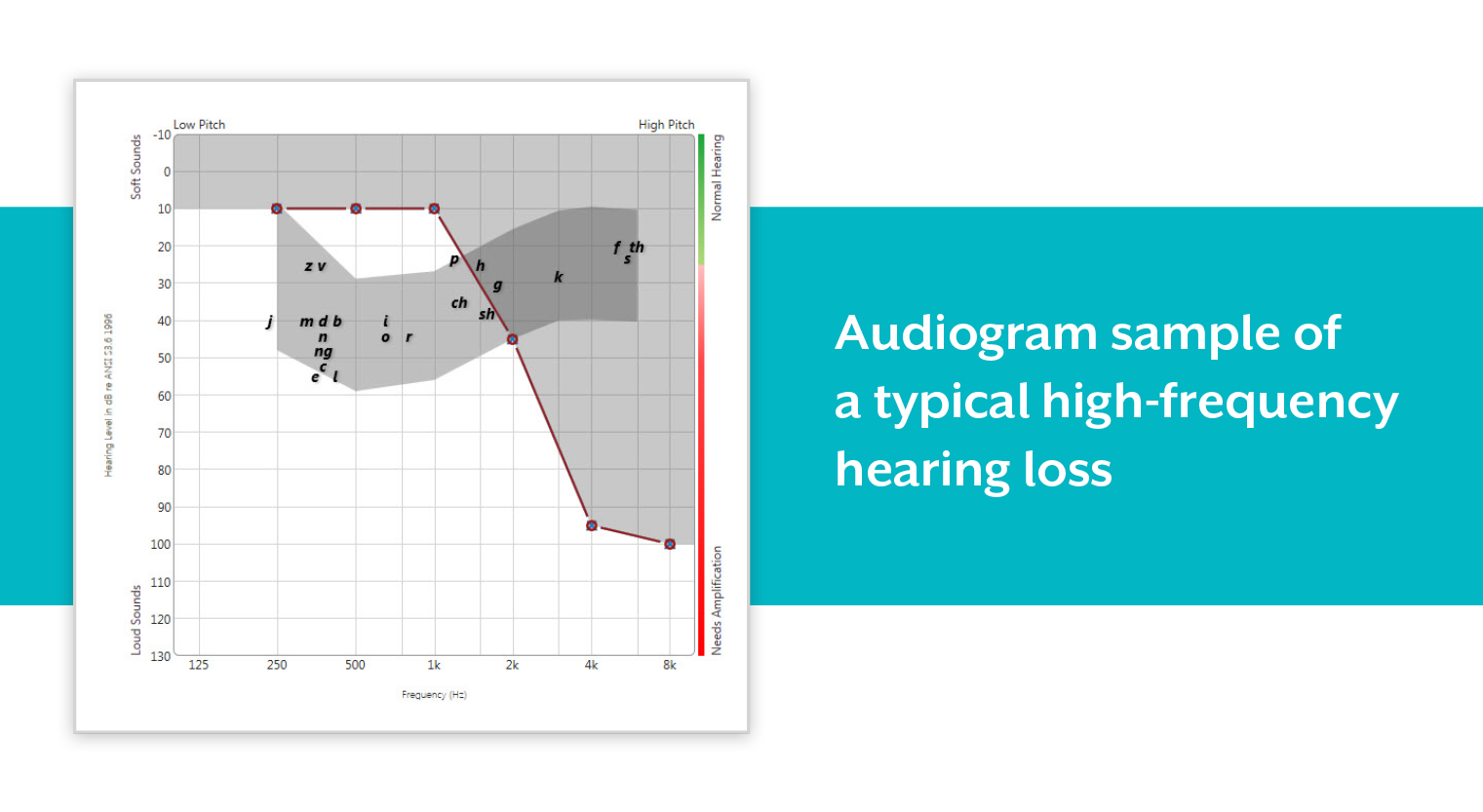
A comprehensive hearing test measures how well you hear across different pitches (frequencies), from low pitches like thunder to high pitches like birds chirping. The results appear on a chart called an audiogram.
On an audiogram, high-frequency hearing loss shows up as a downward slope on the right side of the chart:
The steeper the slope, the more your high-frequency hearing has declined. Even mild high-frequency loss can make restaurants and group conversations exhausting—which is why many people don't realize they have it until communication becomes frustrating.
In our clinics, one of the most common things we hear from patients is some version of:
“I can hear people talking, but I can’t follow the conversation.”
That distinction is important. Hearing loss is not always about loudness. It’s often about clarity, and high-frequency loss disproportionately affects the sounds that give speech meaning.
Here's the key to understanding why high-frequency hearing loss is so frustrating:
Vowels are low-pitched and loud. You can hear them easily. Consonants are high-pitched and soft—but they carry most of the meaning in language.
Think about the words "cat," "bat," "hat," and "sat." The vowel sound "_at" is the same in all of them. The consonant at the beginning is what makes each word different. When you lose high-frequency hearing, you lose those consonants.
This is why:
And it's why restaurants, family gatherings, and group conversations become exhausting—even when one-on-one talks in quiet rooms still work fine.
It's not that you're not paying attention. Your brain is working overtime to fill in the missing pieces.
If you're over 65 and noticing these symptoms, you're in good company, and there's no shame in seeking help.
High-frequency hearing loss isn't a personal failing. It's a natural result of aging and decades of everyday noise exposure.
The question isn't "Am I too young for this?" or "Shouldn't I wait until it's worse?" The question is: "Is this affecting my life, and could treatment help?"
If you're avoiding social situations, asking people to repeat themselves constantly, or feeling exhausted after conversations, that's your answer.
In most adults, high-frequency hearing loss is multifactorial, meaning it develops from a combination of influences rather than a single event.
Common contributors include:
In our clinics, most patients have multiple contributing factors rather than a single cause. This is why prevention focuses on modifiable risk factors like noise protection and cardiovascular health.
Many patients tell me they're surprised to learn they have hearing loss. "I never worked in a noisy factory," they say. "I didn't do anything to cause this."
You don't have to have been a construction worker or rock musician to develop high-frequency hearing loss. Decades of everyday noise, including traffic, restaurants, lawnmowers, concerts you went to in your 20s, all add up. Combined with natural aging, it's more common than not.
The good news? While you can't reverse it, you can protect what you have left and treat what's already declined.
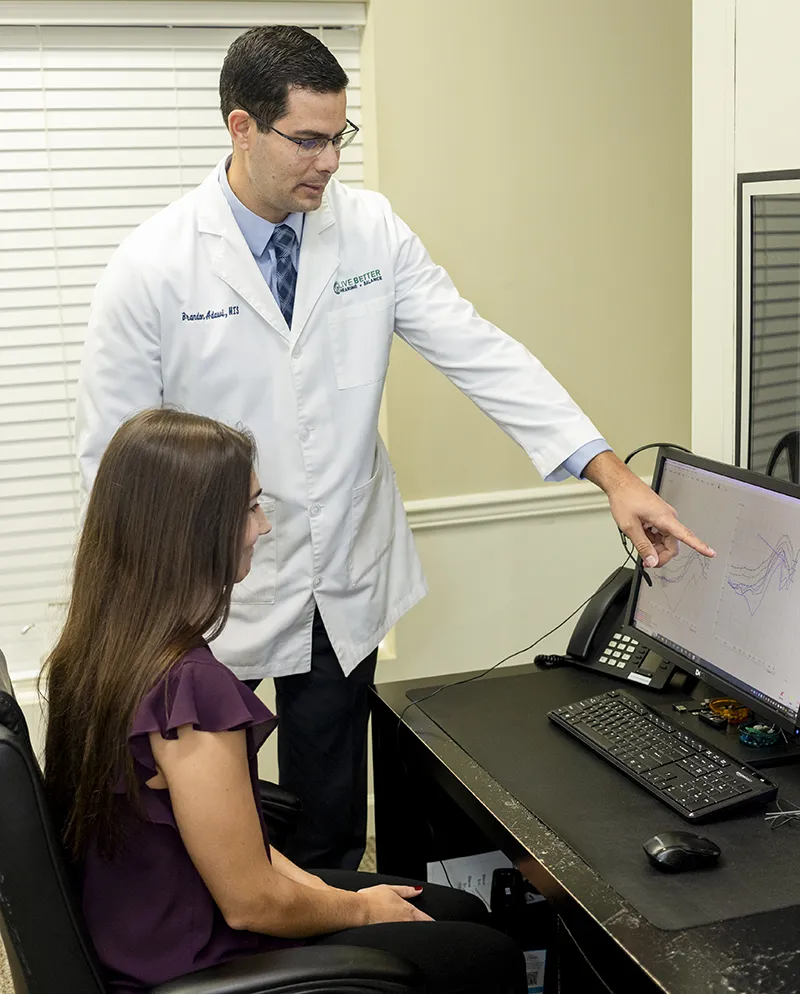
A comprehensive audiologic evaluation is not just about measuring thresholds. It also helps identify:
Audiologists are trained to recognize when hearing changes fall outside expected patterns and may require further medical evaluation.
Not all high-frequency hearing loss requires immediate treatment. Options depend on severity and communication impact:
For mild loss without communication difficulties:
For moderate to severe loss affecting daily communication:
Can supplement or delay need for hearing aids:
Helpful at any stage:
The most effective approach often combines multiple strategies based on individual needs and listening environments.
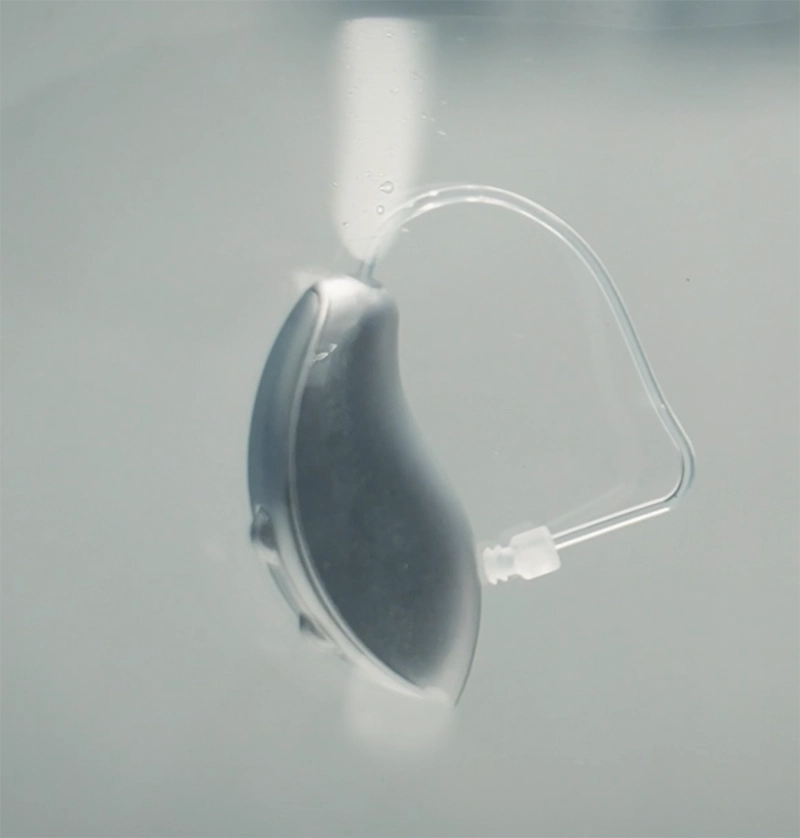
Not everyone with high-frequency hearing loss needs hearing aids immediately. Recommendations depend on:
When hearing aids are recommended, best-practice care includes:
Hearing aids are tools. Outcomes depend heavily on how they are fit, verified, and supported over time.
While age-related hearing changes cannot be fully prevented, protecting hearing can slow progression.
Practical steps include:
Many patients are relieved to learn that early awareness alone can make a meaningful difference.
Adult children and spouses are often the first to notice changes. Caregivers frequently report that their loved one “hears, but doesn’t respond correctly,” or seems withdrawn in conversations.
When family members understand how common high-frequency hearing loss is, it becomes easier to encourage evaluation without blame or pressure. Earlier assessment often leads to less frustration for everyone involved.
If you recognize symptoms of high-frequency hearing loss in yourself or a loved one, here are your next steps:
Even if symptoms are mild, a baseline hearing test shows where you are now and helps track changes over time. The evaluation takes about an hour and gives you a clear picture of your hearing across all frequencies.
You don't need a referral. You can schedule directly with an audiologist.
High-frequency hearing loss can’t be reversed, but it can often be slowed if you:
Many patients are surprised to learn that small changes now can make a meaningful difference later.
This is something we hear often: “I’ll deal with it when it gets worse.”
The challenge is that the longer hearing loss goes untreated, the harder it can be for the brain to adapt to amplification later. Over time, reduced auditory input can make it harder for the brain to efficiently process certain sounds.
Early evaluation almost always leads to better outcomes and less frustration.
Hearing loss affects relationships. Family members may feel frustrated when conversations break down, and you may feel blamed or misunderstood.
When everyone understands what’s happening, communication improves and treatment decisions feel more supportive, not pressured.
Yes. It is one of the most common hearing changes associated with aging and cumulative sound exposure.
Absolutely, and this confuses a lot of people.
You might hear someone talking (that's the vowels, which are louder and lower-pitched), but you miss the consonants that make words distinct. So you hear noise, but you can't understand meaning.
It's incredibly frustrating. Many patients tell me their family accuses them of "selective hearing" or "not paying attention." But it's not that you're not trying. Your ears literally aren't sending the full signal to your brain.
This is one of the most common complaints we hear from patients with high-frequency loss: "I can hear, I just can't understand."
No. Not everyone with high-frequency hearing loss needs hearing aids right away.
If your loss is mild and you're not struggling in daily life, we might recommend:
But if you're:
...then hearing aids are worth considering. When properly fit with Real-Ear Measurement, modern hearing aids can restore speech clarity and significantly improve quality of life.
The decision isn't about what shows up on the audiogram. It's about whether hearing loss is affecting your life in ways that matter to you.
A high-pitch hearing test (also called high-frequency audiometry) measures your ability to hear high-pitched sounds above 2,000 Hz. During the test, you'll listen to increasingly higher-pitched tones through headphones and indicate when you can no longer hear them. This helps identify high-frequency hearing loss, which affects consonants and speech clarity. The test is quick, painless, and part of a comprehensive hearing evaluation.
When properly fit and verified by an audiologist using Real-Ear Measurement, hearing aids can significantly improve speech clarity for many patients with high-frequency loss. Modern hearing aids are specifically designed to amplify high frequencies while preserving natural sound quality. The level of care you receive during the fitting process directly impacts outcomes. Learn more about what distinguishes comprehensive audiology care from retail hearing aid stores.
High-frequency hearing loss makes speech sound muffled or unclear, especially in noisy environments.
Imagine listening to the radio with the treble turned all the way down—everything sounds muddy and unclear. Or imagine trying to understand someone who's talking while chewing food—you hear them, but the words aren't crisp.Consonants like "s," "f," "th," and "sh" become difficult to distinguish. "Sue" and "chew" might sound the same. "Pass the salt" might sound like "Pa_ the _alt."
Children's voices are particularly hard to understand because they're naturally higher-pitched. Same with women's voices compared to men's.
Many patients describe it as "everyone mumbles now" or "people don't speak as clearly as they used to." But it's not them—it's that you're missing the high-frequency information that makes speech clear.
No. Once high-frequency hearing loss develops from aging or noise exposure, the damage to inner ear hair cells is permanent.
Here's what happens: Tiny hair cells in your inner ear detect sound and send signals to your brain. When these cells are damaged (by age, noise, medication, etc.), they don't regenerate. The loss is permanent.
The good news? Hearing aids can effectively restore access to high-frequency sounds you're missing. While they don't "fix" your ears, they amplify the sounds you can't hear naturally, and when properly fit, they can restore 70-90% of speech clarity.
Think of it like glasses. Glasses don't fix your eyes, but they help you see clearly. Hearing aids work the same way.
Early intervention matters. The sooner you address hearing loss, the better your brain adapts to hearing aids and the better your long-term outcomes.
Early evaluation helps establish a baseline and identify changes before frustration builds.
High-frequency hearing loss is common, gradual, and often overlooked, but it doesn't have to control your life.
You might be reading this because you've noticed changes. Maybe you're frustrated that you can't follow conversations in restaurants anymore. Maybe your family is frustrated that you keep asking them to repeat things. Maybe you're worried you're "going deaf" and don't know what to do.
Here's what I want you to know:
This is treatable. You don't have to struggle. And earlier is almost always better.
Hearing health isn't just about detecting sound. It's about understanding your grandchildren's stories, staying connected with your spouse, enjoying social gatherings without exhaustion, and maintaining your confidence and independence as you age.
If you're noticing changes in your hearing clarity, a comprehensive hearing evaluation can give you answers. Even if you're not ready for hearing aids yet, knowing where you stand helps you make informed decisions and protect the hearing you have left.
You deserve to hear clearly and stay connected to the people and moments that matter most.
If you're in Maryland, Virginia, Pennsylvania, or New Jersey, we'd be honored to help. Schedule a comprehensive hearing evaluation at one of our 27 locations.
Medical Disclaimer: This article is for informational purposes only and does not constitute medical advice. Consult a licensed audiologist or physician for personalized hearing healthcare recommendations.